Docs
  • Solver
  • Models
    • Field Service Routing
    • Employee Shift Scheduling
    • Pick-up and Delivery Routing
  • Platform
Try models
  • Timefold Solver SNAPSHOT
  • Deployment
  • Cloud architecture patterns
  • Edit this Page

Timefold Solver SNAPSHOT

    • Introduction
    • PlanningAI concepts
    • Getting started
      • Build as a service
      • Embed as a library
        • Hello World guide
        • Quarkus guide
        • Spring Boot guide
    • Domain modeling
      • Modeling planning problems
      • Domain modeling guide
      • Time patterns
    • Constraints and score
      • Score calculation
      • Understanding the score
      • Adjusting constraints at runtime
      • Load balancing and fairness
      • Performance tips and tricks
    • Running the Solver
      • As a service
        • REST API
        • Model Enrichment
        • Constraint weights
        • Demo data
        • Exposing metrics
      • As a library
        • Configuring Timefold Solver
        • Constraint weights
        • Quarkus integration
        • Spring Boot integration
        • Persistent storage
    • Diagnosing the Solver
      • Benchmarking
      • Solver diagnostics
    • Optimization algorithms
      • Construction heuristics
      • Local search
      • Exhaustive search
      • Custom moves
        • Neighborhoods API
        • Move Selector reference
    • Deployment
      • Cloud architecture patterns
      • Infrastructure requirements
    • Responding to change
    • Example use cases
      • Vehicle routing (guide)
      • More examples on GitHub
    • FAQ
    • New and noteworthy
    • Upgrading Timefold Solver
      • Upgrading Timefold Solver: Overview
      • Upgrade from Timefold Solver 1.x to 2.x
      • Upgrading from OptaPlanner
      • Backwards compatibility
      • Migration guides
        • Variable Listeners to Custom Shadow Variables
        • Chained planning variable to planning list variable
    • Plus/Enterprise Editions
      • Installation
      • Performance improvements
      • Score analysis
      • Recommendation API
      • Nearby selection
      • Multithreaded solving
      • Partitioned search
      • Constraint profiling
      • Multistage moves
      • Throttling best solution events

Cloud architecture patterns

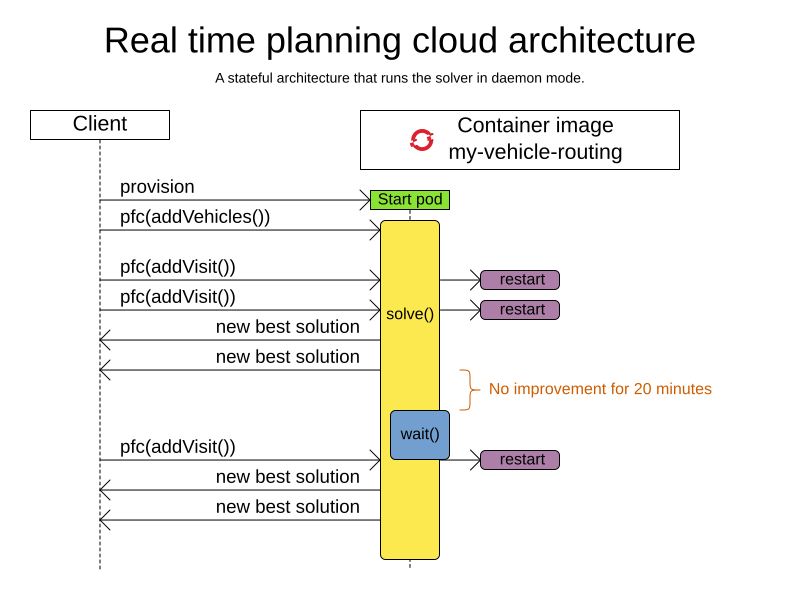
There are two common usage patterns of Timefold Solver in the cloud:

  • Batch planning: Typically runs at night for hours to solve each tenant’s dataset and deliver each schedule for the upcoming day(s) or week(s). Only the final best solution is sent back to the client. This is a good fit for a serverless cloud architecture.

  • Real-time planning: Typically runs during the day, to handle unexpected problem changes as they occur in real-time and sends each best solution as they are discovered to the client.
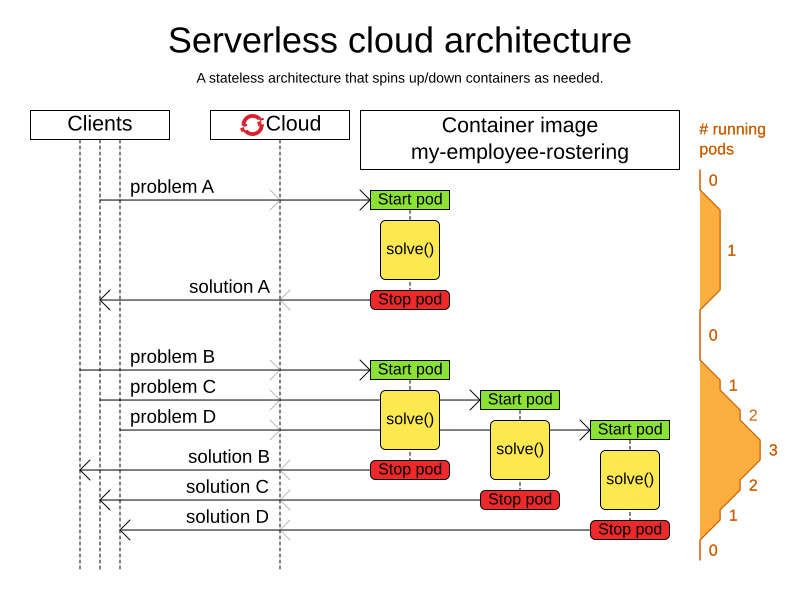
serverlessCloudArchitecture
realTimePlanningCloudArchitecture
  • © 2026 Timefold BV
  • Timefold.ai
  • Documentation
  • Changelog
  • Send feedback
  • Privacy
  • Legal
    • Light mode
    • Dark mode
    • System default